Why Peas Climb and Where to Sow Them
Why peas climb comes down to tendrils that grip reachable supports. Choose a suitable sowing spot and support for your variety, bed, and harvest access.
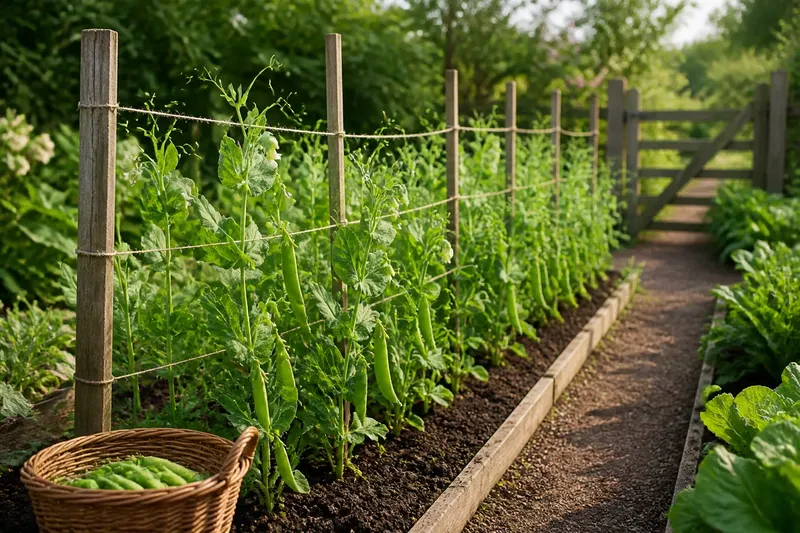
Where should you sow peas so their shoots can climb without blocking a path or sprawling over nearby plants? Sow them in a sunny, accessible bed where the support can stand securely and tendrils can reach it. Why peas climb comes down to those curling tendrils: they grip narrow, nearby objects as the stems grow.
Pea sowing location
Choose a spot with open light, soil that drains rather than staying waterlogged, and room to reach the row from the side. Keep the support clear of gates and paths. If the row sits beside another crop, consider whether the mature vines will shade it.
Follow the seed packet for sowing depth, spacing, and timing because these vary by variety and local conditions. Check the packet’s growth habit, too. A climbing pea needs a support within reach; a compact variety may need only low support or none in a sheltered spot.
In a narrow bed, place a trellis along the row without making the bed edge hard to reach. In a container, use a compact variety and a support fixed firmly in the pot or secured beside it. A tall variety in an exposed position can be awkward in a small container, so check the packet before choosing that combination.
What tendrils do
A pea tendril is a slender plant structure that curls around a narrow object when it touches one. It helps hold the growing shoot upright. Tendrils do not root into a fence or stick to a smooth panel, so give them strands, twigs, or wires they can wrap around.
Keep the support open enough to reach the leaves and pods. A dense tangle can make inspection and picking awkward. The goal is to guide the plants, not bind every stem into place.
Support choices
Netted trellis
Stretch pea netting between stable stakes or a frame. Its openings give tendrils many places to catch, and it suits a defined row of climbing peas. Leave access to the plants where possible. At season’s end, vines may cling to the mesh, so choose a setup that can be removed or cut apart without wrestling with the whole structure.
String or wire frame
Run parallel strings or slim wires between secure uprights. The tendrils can curl around the narrow lines, and the simple layout is easier to inspect than a complicated web. Keep the lowest line near the shoots and avoid sagging lines that press into the foliage.
Brushwood or pea sticks
Push sturdy, branching twigs into the soil near the row. Side branches give shoots several gripping points, making pea sticks useful in a small or informal patch. Use clean branches without sharp ends at hand height, and arrange them so they do not crowd the row or shade it heavily.
It is not worth weaving a delicate lattice or tying every stem individually. A few reachable supports are usually easier to manage, and tendrils can do the rest.
Support and pea type
Climbing varieties send out longer growth and generally need a taller, stable structure. Dwarf or bush peas stay shorter and may stand with little help, but their stems can still lean, especially in an exposed bed. Use the seed description rather than the pea’s intended harvest type to choose support.
Snow peas, snap peas, and shelling peas describe what you harvest, not necessarily how tall the plant grows. Check the variety’s growth habit before sowing, then match the support to its mature growth and the available space.
Set support in time
For climbing peas, install the trellis or frame before sowing. That makes placement easier and avoids pushing stakes among established roots later. For a short patch using pea sticks, add them as shoots emerge, taking care not to disturb the plants.
If shoots grow past a support without catching, gently guide a loose stem toward a nearby strand or twig. Do not pull on a tightly curled tendril. If tendrils cannot reach anything narrow, add strings or slim wires rather than expecting them to grip a broad, smooth fence.
Which sowing setup fits?
Can peas climb a smooth fence?
Not reliably: tendrils need narrow strands or branches to curl around. Attach pea netting, string, or a grid of slim wires, and check that the added support is secure and does not block access.
Can compact peas grow without a trellis?
Some compact varieties can grow with minimal support in a sheltered spot. If stems begin spreading across the soil, add low pea sticks or a line along the bed edge.
Where should peas go in a narrow bed?
Sow them in a row where you can reach the pods from the edge and place a trellis without obstructing a path. Check that the mature vines will not shade a neighboring crop that needs open light.
When should I install pea support?
Put a frame or trellis in place before sowing climbing peas. For compact peas with a few twiggy supports, add the sticks as shoots emerge, keeping them clear of the roots.
Check the site first
- Observe the seed packet’s growth habit; if it says climbing, then install a stable trellis before sowing, otherwise consider low support or no support in a sheltered spot.
- Observe whether the chosen bed receives open light or is shaded by a wall or taller crop; if it is heavily shaded, then choose a brighter available spot, otherwise sow there.
- Observe whether water drains away from the soil or lingers after rain; if it remains waterlogged, then choose a better-drained bed, otherwise use the spot.
- Observe whether you can reach the row from the bed edge; if harvesting would require stepping into the planting, then reposition the row or support, otherwise keep the layout.
- Observe whether the support has narrow strands, twigs, or wires; if it is only a smooth panel, then add a grippable material, otherwise sow beside it.
- Observe whether the support would shade a neighboring crop or block a path; if it would, then move the row or choose a lower support, otherwise proceed with the layout.
A worked sowing choice
Say you have a sheltered, narrow bed beside a path and a seed packet labeled for compact peas. You check the site and find open light, soil that drains, and enough room to reach the row from the bed edge. You decide against a tall frame because the packet describes compact growth and the bed is sheltered.
Before sowing, you place a few sturdy pea sticks beside the planned row, keeping the path clear. As shoots emerge, you check whether their tendrils can reach the twigs. If they catch, the sticks stay; if stems lean toward the path instead, you add a low line along the bed edge. The visible result to watch for is whether shoots remain within the bed and pods stay reachable; if the line still leaves stems sprawling, move to a more supportive frame.
Use the seed packet for variety-specific sowing directions and adjust the setup to the actual site. Why peas climb is useful to remember near sowing time: tendrils can hold shoots only when a suitable grip is close enough, so place the support where the young plants can reach it.